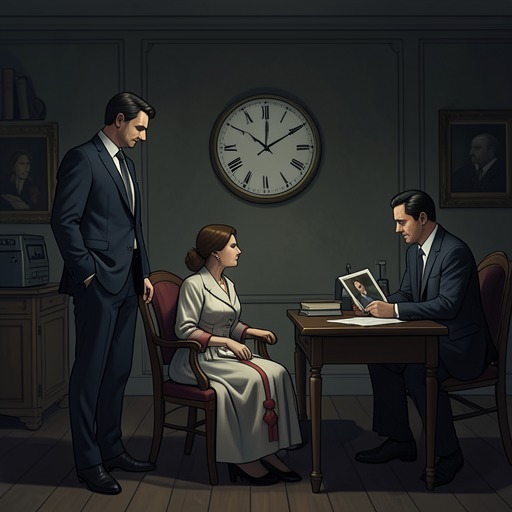
For nearly forty years before the main action
The Pressed-Flower Ritual
Each year on [Henrik Vanger](entity:character-recall-character-henrik-vanger-f4d166386ea3)’s birthday, an anonymous sender mails him a rare pressed flower mounted in a simple frame. The ritual begins after [Harriet Vanger](entity:character-recall-character-harriet-vanger-c7a5fe56abb5)’s disappearance and continues with uncanny regularity, making the flowers seem less like gifts than deliberate reminders of an unresolved crime.
The repeated delivery becomes the private center of Henrik’s life and eventually drives him to seek a final investigator. Its meaning is not understood until the truth emerges: Harriet, alive and hidden abroad, had been sending the flowers through [Anita Vanger](entity:character-recall-character-anita-vanger-0a19366ffd5b) as a quiet sign that she survived.
1992-1994
The Minos Affair
[Hans-Erik Wennerström](entity:character-recall-character-hans-erik-wennerstr-5ef9d44faf8e) obtains sixty million kronor from the [Agency for Industrial Assistance](entity:organization-recall-organization-agency-for-indus-03f3d8783851) for a packaging venture in Poland. Although the Minos factory exists, [Robert Lindberg](entity:character-recall-character-robert-lindberg-22c8f4717a8a) later discovers that its real operation cost only a fraction of the reported investment, suggesting that Wennerström used the state-backed funds as temporary capital and repaid the balance only after profiting from it.
The hidden discrepancy becomes the foundation of [Mikael Blomkvist](entity:character-recall-character-mikael-blomkvist-c157f5f8e49d)’s first investigation into Wennerström. It also establishes the financier’s methods: respectable paperwork, public confidence, and an underlying practice of moving money through structures designed to resist scrutiny.
Friday, December 20
The Libel Conviction
[Mikael Blomkvist](entity:character-recall-character-mikael-blomkvist-c157f5f8e49d) is convicted of aggravated libel against [Hans-Erik Wennerström](entity:character-recall-character-hans-erik-wennerstr-5ef9d44faf8e) and sentenced to three months in prison plus substantial damages. He accepts the verdict without mounting the vigorous defence expected of him, knowing that the article published by [Millennium](entity:organization-recall-organization-millennium-f44334363f6a) contained forged material and that he cannot prove the larger truth behind the deception.
The conviction destroys his professional standing and threatens Millennium’s finances. It also creates the isolation that makes [Henrik Vanger](entity:character-recall-character-henrik-vanger-f4d166386ea3)’s later offer attractive: Blomkvist needs money, distance, and a new subject powerful enough to restore his credibility.
Friday, December 20
Salander’s Investigation
[Dragan Armansky](entity:character-recall-character-dragan-armansky-f2a4c1dd5aaa)’s exceptional researcher, [Lisbeth Salander](entity:character-recall-character-lisbeth-salander-c49c1cff6c3c), prepares a detailed background report on Blomkvist for [Dirch Frode](entity:character-recall-character-dirch-frode-137ac95cf467). She reconstructs his career, finances, relationships, and public reputation, but concludes that his behaviour during the Wennerström trial is inconsistent with his character and suggests that he was deliberately set up.
Her intuition turns a routine background check into the first independent challenge to the official version of Blomkvist’s defeat. Frode’s interest in that assessment leads directly to Salander’s later involvement in the Vanger investigation.
Thursday, December 26
The Vanger Offer
[Henrik Vanger](entity:character-recall-character-henrik-vanger-f4d166386ea3) summons Blomkvist to Hedestad and offers him a highly paid year-long assignment. Officially, Blomkvist is to write a history of the Vanger family; privately, he is to determine what happened to [Harriet Vanger](entity:character-recall-character-harriet-vanger-c7a5fe56abb5), who vanished in 1966 during a chaotic family gathering on Hedeby Island.
Vanger presents the case as a locked-room mystery involving a finite group of relatives and residents. His final inducement is the promise of documentary evidence that Wennerström once embezzled money while working for the [Vanger Corporation](entity:organization-recall-organization-vanger-corporati-c4063d7c29f2), binding Blomkvist’s professional recovery to the old disappearance.
Saturday, September 24, 1966
The Hedeby Bridge Accident
A tanker truck collides with a car on the bridge connecting Hedeby Island to the mainland. The accident spills heating oil across the bridge, blocks traffic for a full day, and draws police, firefighters, reporters, relatives, and sightseers into a concentrated scene of confusion.
Harriet returns from Hedestad shortly before the crash, speaks with Henrik, and is later seen near the bridge. Because the accident traps the island and absorbs everyone’s attention, it becomes the perfect apparent setting for a disappearance that can be mistaken for an accident or flight.
Saturday, September 24, 1966
Harriet Disappears
[Harriet Vanger](entity:character-recall-character-harriet-vanger-c7a5fe56abb5) is last seen alive after encountering Pastor [Otto Falk](entity:character-recall-character-otto-falk-6e1346d05a6d) while the island is cut off by the bridge accident. By dinner her absence is noticed, and the next morning the family reports that she has vanished without taking her purse, money, or obvious belongings.
Search parties comb the island, the shore, buildings, wells, woods, and nearby waters, but find no body or trace. The absence of physical evidence leaves Henrik with the conviction that a family member hid her remains, while the official investigation gradually closes without proving that a murder occurred.
September 1966 and the following days
The Investigation Closes
Inspector [Gustaf Morell](entity:character-recall-character-gustaf-morell-c003966428c6) conducts a broad and methodical investigation into Harriet’s disappearance. He interviews the family, searches the island, checks boats and transport routes, circulates an alert, and pursues the possibility that Harriet fled or suffered an accident.
The inquiry finds no credible route off the island, no body, and no motive. Morell’s thoroughness later convinces Blomkvist that the answer will not be found by merely rereading the police file; it must come from a new interpretation of overlooked patterns and relationships.
December and January
Salander’s Guardianship
After [Holger Palmgren](entity:character-recall-character-holger-palmgren-fc3505b8ae56) suffers a stroke, [Nils Erik Bjurman](entity:character-recall-character-nils-erik-bjurman-84f20a3deb8f) becomes Salander’s legal guardian. Unlike Palmgren, he imposes strict control over her money, limits her spending, interrogates her about her work and sex life, and treats her as an incompetent dependent rather than an adult capable of directing her own life.
The guardianship places Salander in a position of institutional vulnerability. It also gives Bjurman coercive power, setting up the abuse that becomes one of the novel’s parallel investigations into male authority and violence against women.
Friday, January 3
Blomkvist Moves To Hedeby
Blomkvist returns to Hedeby and settles into the guest house across from the Vanger estate. He accepts the public fiction that he is writing Henrik’s autobiography while privately beginning to read the massive police file, notebooks, photographs, and family records concerning Harriet.
The isolated setting initially feels like exile, but the routine gives Blomkvist space to recover from the trial. The village’s inhabitants, the divided Vanger family, and the old documents gradually transform the assignment from an absurd paid sabbatical into an investigation he cannot easily abandon.
January-February
The Vanger Family History
As Blomkvist interviews Henrik, he reconstructs a family marked by industrial power, inherited shares, Nazism, racism, domestic cruelty, alcoholism, and internal hatred. Henrik’s brothers include fascists and racial theorists, while [Gottfried Vanger](entity:character-recall-character-gottfried-vanger-d840456e2f96) emerges as a weak, alcoholic man whose chaotic home leaves both Harriet and Martin exposed.
The family chronicle becomes more than a cover story. It reveals a culture in which violence and secrecy pass between generations, and it supplies the social context in which Harriet’s disappearance and the later crimes can be understood.
February
The Bjurman Assault
Bjurman first sexually molests Salander in his office, then coerces her into oral sex by threatening institutionalisation and exploiting his legal control over her finances. When she later returns for money, he violently restrains and rapes her in his apartment, using handcuffs and other instruments of sexual brutality.
Salander refuses to report him because she expects the authorities to believe his documents and social position over her testimony. Instead, she begins a private campaign to reclaim control, treating the assault as an attack that must be answered through planning rather than impulsive violence.
March
Salander’s Revenge
Salander returns to Bjurman’s apartment equipped with a taser and incapacitates him. She restrains him, records evidence of his rape, and forces him to promise restored access to her bank account, favourable guardianship reports, and eventual support for ending her guardianship.
She then tattoos a declaration across his torso identifying him as a sadistic pig, pervert, and rapist. The revenge does not merely punish Bjurman; it reverses the power relation and gives Salander a weapon capable of protecting her future.
Saturday, February 1
The Millennium Partnership
[Henrik Vanger](entity:character-recall-character-henrik-vanger-f4d166386ea3) offers to invest in [Millennium](entity:organization-recall-organization-millennium-f44334363f6a) and join its board, using his resources to counter Wennerström’s campaign against the magazine. [Erika Berger](entity:character-recall-character-erika-berger-d05198fc797e) negotiates a four-year arrangement that will cover the publication’s losses, while Blomkvist is expected eventually to resume his role as publisher.
The agreement stabilises Millennium and publicly signals that Wennerström’s enemies are willing to fight back. It also creates an ethical complication: Blomkvist’s employer and financial rescuer is now tied to the very family whose secrets he is investigating.
February-March
The Leviticus Code
Blomkvist notices five unexplained names and number sequences in Harriet’s date book. His daughter Pernilla, whose Bible studies have made her familiar with the text, helps him realise that the numbers refer to chapters and verses in Leviticus rather than telephone numbers.
The verses concern grotesque punishments involving sexual transgression, fire, animals, menstruation, and religious impurity. The code transforms Harriet’s private religious interest into an encoded catalogue of crimes and points Blomkvist toward the unsolved murder of Rebecka Jacobsson.
1949, discovered as a clue in June
The Rebecka Jacobsson Murder
Rebecca Jacobson was an employee of the Weng Group. She was raped and murdered in Hederstad, her head pressed into a burning fire. The crime has never been solved, but Harriet Van Eyck's cipher linked the initial letters "R.J." and the description of the body
During the year before September 1966
Harriet’s Disturbing Change
Police interviews showed that Harriet Van Eyck became quiet, distant, and cold, and increasingly focused on religious studies. She attended worship services, studied Pentecostal and Catholic teachings, wrote mysterious names and numbers in the back of her diary, while keeping her thoughts hidden from friends and family
Early June
The Järnvägsgatan Photograph
Michael Blomkvist re-examined the first photo in the accident photo set. The photo shows [Harriet Vanger](entity:character-recall-character-harriet-vanger-c7a5fe56abb5) participating in a children's festival before returning to Hedeby Island. Unlike everyone else around her, Harriet Vanger did not watch the festival; instead, she looked away
Early June
The Norsjö Photograph
Michael Blomkvist identified a honeymoon couple standing beside [Harriet Vanger](entity:character-recall-character-harriet-vanger-c7a5fe56abb5) at the celebration. Their car had a sticker from Nurla Woodworking, allowing him to track them down through former employees, eventually finding Mildred Blunden, who still had the travel negatives. Her photo showed a blurry
June-July
The Biblical Murder Pattern
[Lisbeth Salander](entity:character-recall-character-lisbeth-salander-c49c1cff6c3c) studied the names and passages in the Harriet Van Helsing cipher, confirming that a series of female murders had occurred in various parts of Sweden. The victims included Rebecca Jacobson, Mary Holmberg, Rachel Lund, Magda Lovisa Svedberg, Sara Vitt
Early July
The Vanger Corporate Connection
[Lisbeth Salander](entity:character-recall-character-lisbeth-salander-c49c1cff6c3c) compared the location and date of the murder with the company's industrial activities when she searched the Weng Group archives. She found that Gottfried Van Yer frequently appeared near several crime scenes during his business trips for the company, such as negotiations, factory openings, or labor disputes
Early July
The Cat Warning
Someone placed the half-burned corpse of a red-brown cat outside [Mikael Blomkvist](entity:character-recall-character-mikael-blomkvist-c157f5f8e49d)'s cottage. The cat's head was placed on [Lisbeth Salander](entity:character-recall-character-lisbeth-salander-c49c1cff6c3c)'s motorcycle, and the body and internal organs were arranged in a clear imitation of the sacrificial imagery in Harriet Van der
Thursday, July 10
The Shooting At The Fortress
Michael Blomkvist was shot three times while running near an old wartime fortress. The first shot's fragments injured him, and he took cover, then moved through the underbrush and bypassed Esterberg to escape, avoiding exposure to the shooter. This attack confirmed that someone was willing to kill
Friday, July 11
Anita Identified In The Window
Michael Blomkvist compared the blurry female figure in [Harriet Vanger](entity:character-recall-character-harriet-vanger-c7a5fe56abb5)'s bedroom window with family photos and realized he had mistaken [Anita Vanger](entity:character-recall-character-anita-vanger-0a19366ffd5b) for her almost identical sister Cecilie Vanger. This discovery explains why the woman in the photo could never be correctly identified and also explains why Cecilie V
Friday, July 11
Martin’s Murder Chamber
Michael Blomkvist tracks [Martin Vanger](entity:character-recall-character-martin-vanger-fd1363f34905) to Martin Vanger's villa and basement, discovering a locked basement equipped with restraints, chains, recording devices, steel cages, and sexual assault equipment. Martin Vanger grabs Michael Blomkvist, beats him, and puts him in handcuffs
During Martin’s confession on Friday, July 11
The Gottfried Legacy
Martin Van Yer admitted that his father, Gottfried Van Yer, guided him into participating in the abuse and murder of women. He witnessed the killing of Lija Persson and personally strangled Sara Vitt, continuing the ritualized violence of the family after Gottfried Van Yer's death
Early morning, Saturday, July 12
Salander Rescues Blomkvist
[Lisbeth Salander](entity:character-recall-character-lisbeth-salander-c49c1cff6c3c) returns to [Martin Vanger](entity:character-recall-character-martin-vanger-fd1363f34905)'s villa and basement, finding [Mikael Blomkvist](entity:character-recall-character-mikael-blomkvist-c157f5f8e49d) hanging by a noose, and attacks Martin Vanger with a golf club. She pushes Martin Vanger away from the gun, cuts the rope and saves Mikael Blomkvist
Saturday, July 12
Martin Vanger’s Death
[Martin Vanger](entity:character-recall-character-martin-vanger-fd1363f34905) fled south along the European Route 4, [Lisbeth Salander](entity:character-recall-character-lisbeth-salander-c49c1cff6c3c) chased him on a motorcycle. He drove into the oncoming truck lane, and died in the subsequent collision. The immediate threat seemed to disappear. The death of Martin Vanger ended the known killing spree, but left the
July 12-14
Harriet’s Escape Revealed
[Lisbeth Salander](entity:character-recall-character-lisbeth-salander-c49c1cff6c3c) found [Martin Vanger](entity:character-recall-character-martin-vanger-fd1363f34905)'s victim files, photos, and potential victim records, then destroyed or took away a large amount of evidence. [Mikael Blomkvist](entity:character-recall-character-mikael-blomkvist-c157f5f8e49d) and Lisbeth Salander reconstructed the past. Gösta Vanger abused [Harriet Vanger](entity:character-recall-character-harriet-vanger-c7a5fe56abb5), Martin Vanger continued
Tuesday, July 15
Harriet Returns From Australia
Michael Blomkvist went to Australia after tracing the phone call that [Anita Vanger](entity:character-recall-character-anita-vanger-0a19366ffd5b) made to Cockron Farm. There, he discovered that [Harriet Vanger](entity:character-recall-character-harriet-vanger-c7a5fe56abb5) was still alive and was living under the identity of Anita Cockron. She was a successful sheep farmer who had established a family and business far
Tuesday, July 15
Harriet Confesses To Gottfried’s Death
Harriet tells Blomkvist that Gottfried raped and tortured her at his cabin in August 1965. When he attacks her and tries to strangle her, she escapes, pushes him into the water, and holds him under with an oar until he stops struggling.
Martin witnesses the aftermath and then rapes Harriet himself, gaining power over her through the secret of her father’s death. Harriet’s flight was therefore driven by two intertwined crimes: the abuse inflicted on her and her terror that revealing her father’s murder would make her appear guilty rather than victimised.
Saturday, July 26
Henrik Meets Harriet
Blomkvist brings Harriet to Henrik in the hospital and tells him that she survived. Henrik is overwhelmed but welcomes her, grieving that she suffered alone and that he failed to give her the chance to seek his help.
Harriet’s return resolves the central disappearance while leaving the family to confront its hidden crimes. The emotional reunion also makes clear why Henrik will later ask Blomkvist not to publish the full truth: protecting Harriet and preserving the company have become inseparable concerns.
Late July
The Cover-Up Agreement
Henrik asks Blomkvist not to publish the truth about Gottfried and Martin, warning that the revelation would destroy Harriet and endanger thousands of employees. Blomkvist accepts the silence after Salander demands practical restitution: the company must identify Martin’s victims where possible and fund women’s crisis centres in perpetuity.
Blomkvist feels that he has betrayed his journalistic vocation, but he chooses the living victim over a story that would expose her again. The compromise becomes the novel’s most difficult ethical decision, opposing professional truth-telling to human protection and responsibility.
Late July
The Wennerström Evidence
Frode reveals that Henrik can document Wennerström’s early fraud inside the [Vanger Corporation](entity:organization-recall-organization-vanger-corporati-c4063d7c29f2): unauthorised currency speculation, concealed losses, cooked books, and the theft of roughly half a million kronor that became the seed capital for the [Wennerström Group](entity:organization-recall-organization-wennerstr-m-grou-0336aa692b02).
Blomkvist recognises that Henrik had used Wennerström as bait and that the evidence, though genuine, is too old to destroy the financier by itself. His anger at being manipulated pushes him back toward the unfinished struggle with Wennerström.
Early August
Salander Reveals Wennerström’s Crimes
Salander tells Blomkvist that she secretly copied Wennerström’s entire hard drive and found evidence of weapons trafficking, money laundering, criminal networks, and the abuse of a pregnant waitress. She can provide documentary proof of the financial empire’s criminal structure rather than relying on the forged material that ruined Blomkvist’s first exposé.
The discovery gives [Millennium](entity:organization-recall-organization-millennium-f44334363f6a) a credible second chance. It also turns Salander from a hired research assistant into the decisive source whose technical skills make the new investigation possible.
August-October
The Millennium Counterintelligence Operation
Blomkvist and the [Millennium](entity:organization-recall-organization-millennium-f44334363f6a) staff discover that managing editor [Janne Dahlman](entity:character-recall-character-janne-dahlman-273b175dfeaa) is leaking editorial plans to [Monopoly Financial Magazine](entity:organization-recall-organization-monopoly-financi-ec110d6af7ec), which is owned by Wennerström. Instead of firing him immediately, they create a controlled deception: the staff will pretend that Millennium is collapsing while secretly preparing a massive exposé.
The operation uses false financial reports, staged quarrels, deliberate rumours, and strict oral communication. It turns Wennerström’s confidence in his informer into a vulnerability and protects the magazine while the evidence is organised.
Early November
Salander’s Hostile Takeover
Salander maps Wennerström’s maze of offshore companies, bank accounts, hidden assets, and criminal transactions. Disguised as Monica Sholes and Irene Nesser, she travels to Zürich, transfers funds from Wennerström’s Cayman account, converts bonds through private banks, and disperses the money into accounts she controls.
The operation is both financial retaliation and a practical safeguard against Wennerström’s future power. Salander uses his own opaque system against him, transforming the hidden wealth that supported his criminal empire into an asset that can no longer protect him.
Thursday, November 27
The Millennium Exposé
[Millennium](entity:organization-recall-organization-millennium-f44334363f6a) publishes a forty-six-page investigation into Wennerström under the joint byline of Blomkvist and Berger. The report includes emails, secret agreements, balance sheets, and evidence from Wennerström’s own computer, making the allegations far more defensible than the forged material behind the earlier libel conviction.
The Swedish media initially hesitate, but television coverage and the documentary weight of the evidence trigger a national financial scandal. The Wennerström empire becomes associated with organised crime, money laundering, illegal arms dealing, and fraud on a scale that dwarfs previous Swedish financial scandals.
Early December
The Mafia Banker Published
Blomkvist publishes [The Mafia Banker](entity:object-recall-object-the-mafia-banker-27fe44a3898b) through [Millennium](entity:organization-recall-organization-millennium-f44334363f6a)’s new publishing imprint, expanding the exposé into a heavily documented book. Much of the volume consists of source material reproduced from Wennerström’s computer, allowing readers and investigators to examine the evidence directly.
The book sells rapidly and restores Blomkvist’s professional reputation. The earlier conviction is reinterpreted by the public as the consequence of protecting a source, while Millennium becomes the centre of a media storm that it has deliberately prepared to survive.
December and the following months
The Collapse Of Wennerström
The exposé triggers investigations, a securities sell-off, international scrutiny, and the collapse of the [Wennerström Group](entity:organization-recall-organization-wennerstr-m-grou-0336aa692b02). Wennerström flees Sweden and later lives under a false identity in Spain, while Salander tracks his movements through the compromised computer system.
Wennerström is eventually found shot dead in Marbella. The official explanation suggests a burglary, but Salander understands that his death follows the disappearance of his hidden fortune and the criminal networks that had depended on it.
Tuesday, December 30
Salander Leaves The Gift
After Christmas, Salander realises that she is in love with Blomkvist and decides to visit him with a vintage Elvis sign as a gift. On the way she sees him leaving a café with [Erika Berger](entity:character-recall-character-erika-berger-d05198fc797e), their intimacy making it clear that she has arrived too late or misunderstood the place she occupies in his life.
The pain overwhelms her, and she abandons the gift in a dumpster before returning to her cleaned apartment. The novel ends with Salander retreating behind her defences, while her attachment to Blomkvist remains unresolved and vulnerable.